Published in the Daily Express on 12 October 2026.
In his latest Ukraine dispatch, Lord Ashcroft meets Anastasia Vistorobska who gave up life in France to work as a frontline medic… despite being Russian.
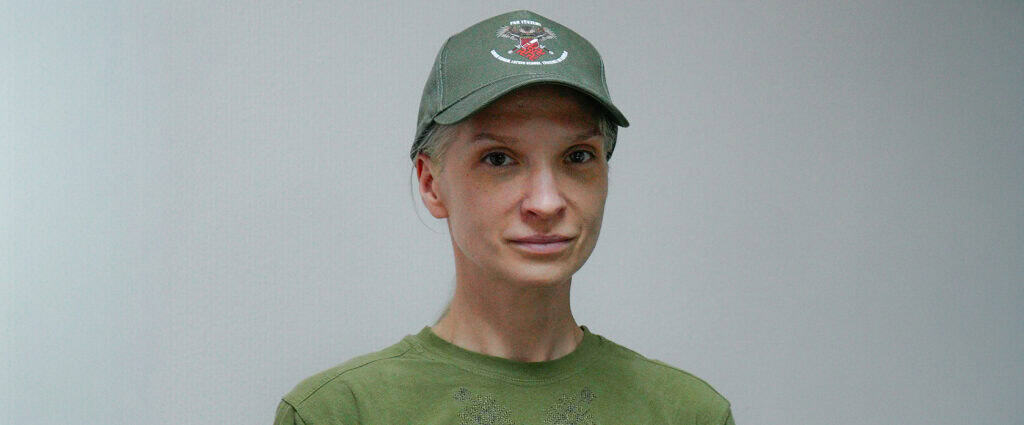
Less than five years ago, her life could hardly have been more glamorous or safer. Anastasia Vistorobska worked in Paris for two of the world’s best- known fashion houses. Today her life could hardly be more challenging or dangerous: working as a combat medic for Ukraine’s armed forces on the front line of its brutal all-out war with Russia.
Anastasia’s story is all-the-more remarkable because of her nationality – she is Russian, which means she has volunteered to risk her life fighting against her homeland. For more than two-and-a-half years, she has worked as a combat medic, treating her comrades close to the front line, while also seeing countless others die on the battlefield.
It is physically and mentally exhausting work. Typically, Anastasia’s days are full of both good and bad news. She fought back tears as she talked about the recent death of a close comrade. “The constant death is terrible. It builds up and it makes me sad and angry. I have seen 42 comrades go on a mission but only 38 came back,” she reflects.
However, there are rewarding days too. “On one occasion, a wounded soldier passed on a message through a comrade: ‘Thank you for saving my life.’ That was very inspiring. I am fortunate, too, that I have never had anyone die in my arms.” On February 24, 2022, when Russia began its all-out invasion, Anastasia was sleepingin a beautiful house in rural France, when suddenly friends started messaging her that the war had started. “They all said the same: that Ukraine was under bombardment. My immediate reaction was: ‘this cannot be happening!’”
At that time, Anastasia, then aged 36, had lived in France for 15 years, for the last seven working in the fashion industry for Chanel and Givenchy as an embroidery designer. With friends and relatives in Ukraine, she typically visited the country twice a year. “After the all-out invasion, I wanted to join the Ukrainian army straight away but I felt helpless. I was conscious that I had a Russian passport and no previous military experiences. I feared that I would be useless and that no one would take me seriously. But I do have an ability to act decisively. I wanted to go and start killing these invaders.”
As she pondered how to get involved, the Russian massacre of some 500 people at Bucha, near Kyiv, in March 2022, was the final straw. “For me, this was the most horrific moment of the whole war,” she said. Anastasia initially wrote a letter to a military committee in Ukraine explaining: “I know I am Russian but I want to go and defend Ukrainian children. Can you please accept me?”
Her offer was rejected but friends advised her to look into the Freedom of Russian Legion, Russians fighting against their homeland. “I looked at their videos and documentaries and I was astounded by the way they thought and spoke. They seemed to be the best of people and, four years on, having met them, I still feel the same.”
Fearing she was too old and too weak, Anastasia first got herself fitter and stronger over six months before going to Texas, America, for a two-month military training course. Eventually, she passed a long vetting procedure and was successful in joining the legion. “The process is strict: Every potential recruit’s background is scrutinised down to the smallest detail to completely eliminate any possibility of FSB [Russian security] infiltration,” she said.
It was not until February 2024, on the second anniversary of the full-scale invasion, that she finally arrived in Ukraine and started undergoing four months of training at a secret location. “It was horrible – really, really hard – but at the end of it I could shoot five different weapons and I learnt a lot about the battlefield and communications. I also learnt medical skills and evacuation techniques.”
At the end of her training, she chose to work as a combat medic and is now head of a tactical evacuation team. Typically, she operates some six miles from the front line. The aim is that an injured soldier is given basic first aid and evacuated by his comrades, so he or she can receive fuller medical attention from combat medics in slightly safer locations.
I asked Anastasia, who is 5ft 8ins tall and of slim build, how she felt fighting a war against her homeland. “I prefer to judge people on their actions rather than their passport. People either do good things or bad things and I want to be on the side of right versus wrong. Stealing land, killing civilians, harming children – they are all wrong.” Strangely perhaps, Anastasia considers it more dangerous to be in Kyiv on leave than she does working close to the front line. The capital is hit almost daily by ballistic missiles and jet-powered drones.
“In the warzone, I am wearing body armour, I am surrounded by comrades, I am always on alert and I trust my commanders to keep me safe. But in Kyiv this summer I was sleeping in my pyjamas on the 14th floor of an apartment building when the area was being hit by missiles and drones. That was terrifying.”
Her worst times have come when comrades are being killed or wounded on the front line. “When you hear someone screaming [for help] on the radio that’s probably one of the hardest moments,” she said.
Anastasia, who left Russia aged 23, has signed a three-year contract with the legion. She does not know yet if she will stay in the army longer because she also has a yearning to go back to her artistic roots. Even now, she applies her talents by creating artistic projects, including making art works from the uniforms of dead soldiers and their belongings. It is intended as a memorial to their sacrifice and, in time, she hopes to exhibit her work. Hundreds of Russians are currently fighting for Ukraine and Anastasia admires them all.
“I am soaked in the stories of my comrades, their chivalry and bravery,’ she said “But what upsets me is that after they die in battle and are cremated, no one [from their family] will come and visit their grave. So I hope my work will commemorate their death, their memory. The huge power of war and art often go hand in hand.”
For security reasons, Anastasia prefers not to discuss details of her family. However, she says all her family members, including her mother, now live outside Russia, which is why she is willing to be identified by name, without fear of reprisals in her homeland.
“I am not scared by the reality that I might get killed. I am just proud to have done a little bit to make the situation better for Ukrainians. Putin is scared of the Legion of Russia which means he is scared of me.”
Her hatred of the Russian president has no limits. She says: “He is one of the biggest war criminals in history. He has beencompared to Hitler but he is much worse than Hitler. Putin is destroying Russia even more horribly than he is Ukraine. “He stole my pride and my joy at being Russian. He has stolen the right of the Russian language to be the beautiful language it once was.”
She hopes that, once the war ends well for Ukraine, she will be able to divide her time between France and Ukraine. Now aged 41 years old, she is engaged to a Russian man who also serves in the legion. Anastasia says Ukrainians have been largely supportive, rather than suspicious, of her and other Russians fighting for their cause, but she added: “If a Ukrainianwas to spit in my face, I would not say a word because I would understand theanger. The reality is that Russia owes a huge debt to Ukraine.”
Read this article on Express.co.uk
DOWNLOAD PDF