Published in the Daily Express on 08 September 2026.
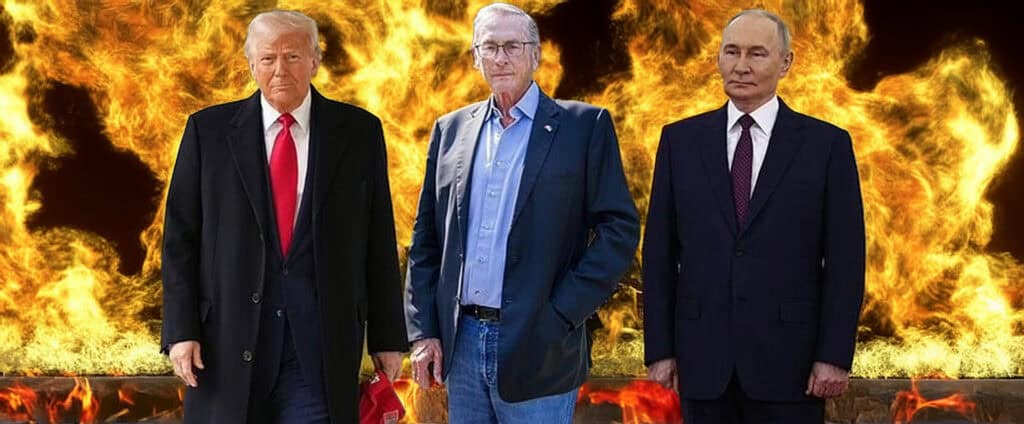
The arrival of the US’s two most senior peace negotiators in Ukraine at the weekend is highly significant. It is the first time that Steve Witkoff and Jared Kushner, the most trusted members of President Donald Trump’s inner team, have visited the war-torn country. Over the past two years, Witkoff has turned down several invitations to travel to Kyiv. He has instead preferred to visit Moscow numerous times to meet Vladimir Putin and senior Russian diplomats. The visit to Ukraine by Witkoff, a wealthy entrepreneur, and Kushner, Trump’s son-in-law, is significant for several reasons.
First, it clearly indicates that the US now acknowledges that any peace deal must be acceptable to both Ukraine and Russia. Previously, Trump, Witkoff and others had swallowed Russian propaganda that, if President Volodymyr Zelensky did not accept an agreement on President Putin’s one-sided terms, Ukraine would be crushed by the might of the Russian military.
The reality has been very different: Ukraine’s dogged resistance has meant that for many months there has been a virtual stalemate on the front line, while Russia continues to hold some 20% of Ukraine’s territory. Furthermore, in recent months, Ukraine’s medium and long-range drones have caused havoc to Russian supply lines, the nation’s economy and the Russian people’s attitude to the war.
Secondly, the fact that Kushner and Witkoff travelled first to Moscow on Saturday and then immediately to Kyiv suggests that the US has come up with some major new proposals that its president thinks both sides may be willing to accept.
Trump, who, while campaigning to win a second term as US President, claimed he would end the war within a day, would not be dispatching the two men to both capital cities unless he believed they had a realistic chance of securing an agreement.
Thirdly, the visit from Witkoff and Kushner is significant because they will have seen, if only briefly, that Ukraine is anything but a nation run by Nazis and gangsters as Putin and his cronies have tried to portray. Instead, Ukraine is a noble country with a resilient people who have bravely resisted the aggression of a larger and more powerful neighbour for more than four and a half years of all-out war.
Significantly, when Laura Loomer, an American right-wing activist and Trump supporter, visited Ukraine for the first time this summer, it completely changed her attitude toward the war. During her ten-day visit, she tweeted: “I feel like such an asshole for minimising the struggle of Ukrainians for the last five years… We have been so propagandised by Russia.”
I am currently in Kyiv for my sixteenth visit to Ukraine since the start of the all-out war in February 2022. Unlike Witkoff and Kushner, I have had the opportunity to meet and interview scores of courageous individuals from the Armed Forces of Ukraine and civilian life. The majority of Ukrainians are weary of war, but, having sacrificed so much for so long, they crave a “fair” peace deal backed up by strong security guarantees.
All parties – the US, Ukraine and Russia – have been reluctant to reveal details of the new peace plan, but Trump now knows that Zelensky will not be bullied into accepting the sort of deal that Putin has repeatedly demanded. While Zelensky accepts that Ukraine might have to agree to “freeze” the frontline, he is not willing to hand over territory that remains in Ukraine’s possession.
The US negotiators said their talks in Moscow on Sunday with Putin and others had yielded “significant progress”, while their talks in Kyiv had been encouraging and “substantive”, despite no immediate breakthrough. Zelensky once again stressed the need for a just and lasting peace.
The reality is that both Russia and Ukraine need the war – which has resulted in an estimated two-and-a-half million casualties (dead and wounded) – to end. The long-range strikes are causing immense harm to the infrastructure and economies of both nations and casualties, civilian as well as military, grow substantially by the day.
The visit by the US peace negotiators to Kyiv is an important step to ending Europe’s biggest conflict since the Second World War. However, there is clearly much work still to be done. As Gabriel García Márquez, the Nobel Prize-winning writer, noted: “It is easier to start a war than to end it.”
Read this article on Express.co.uk
DOWNLOAD PDF