Published on KyivPost.com on 20 May 2026.
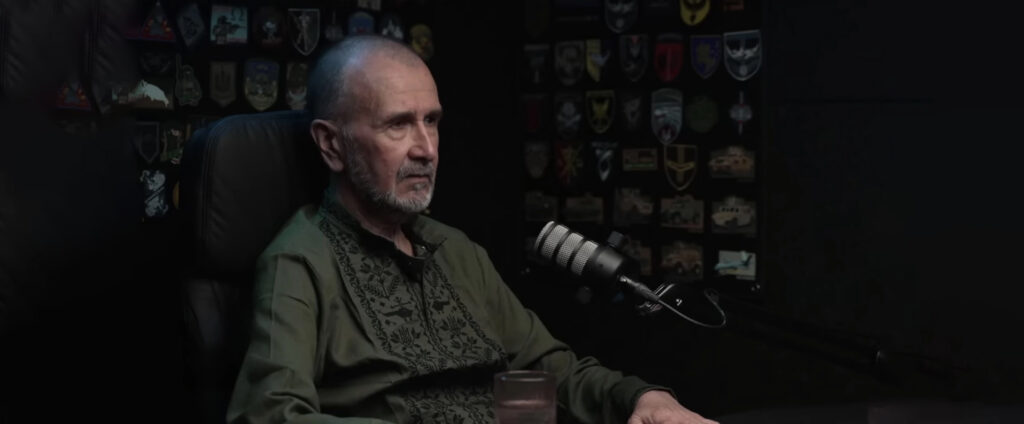
There was something striking about him. His bright eyes carried a mixture of pain and quiet resolve, almost overshadowing his still slender frame – a lingering trace of the years he had endured in Russian captivity. After a brief exchange about my own visit to Kherson, we began our conversation, which, I confess, more than once brought tears to my eyes.
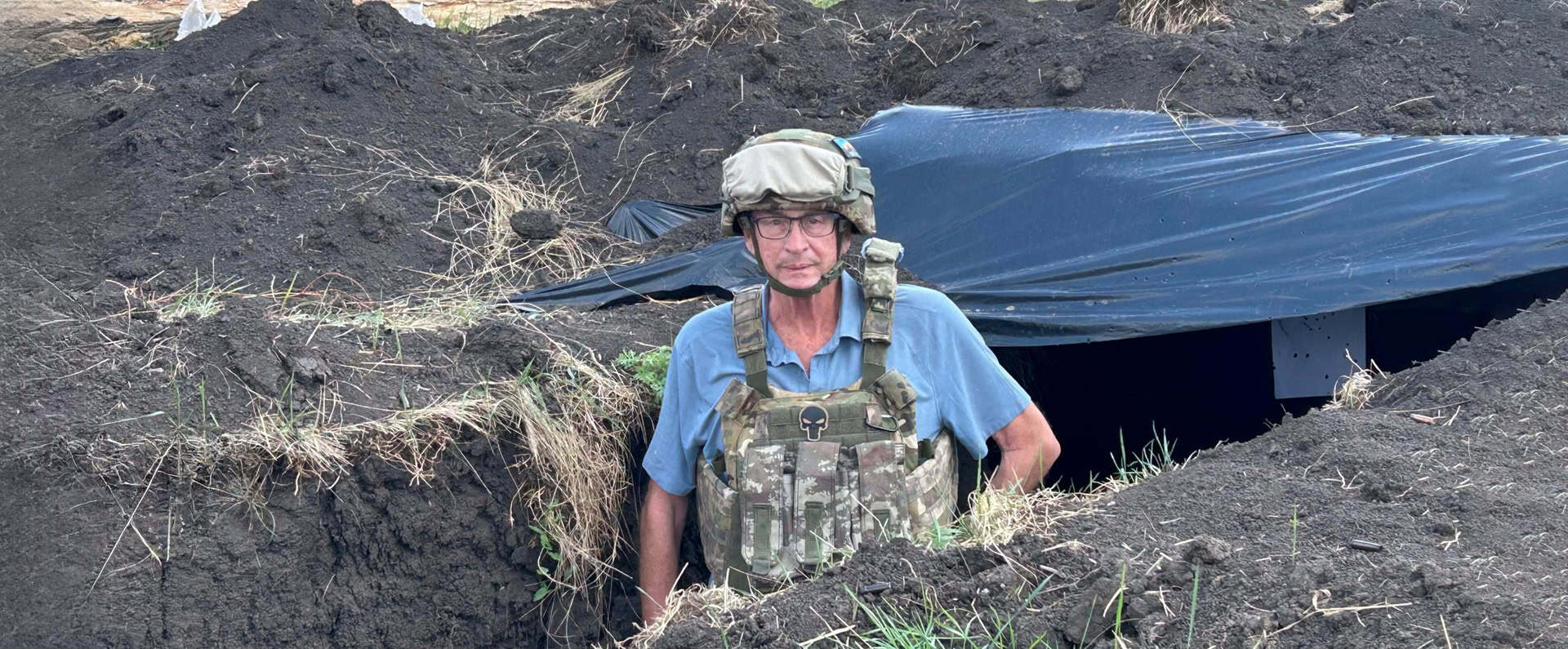
I met Volodymyr Mykolaienko in Kyiv where he had travelled all the way from the frontline city of Kherson especially to meet with me. The journey itself has been precarious. The night before his train has been held for four hours at a station as Russian strikes pounded the region. For a time, I wondered if we would meet at all.
“How could I not make it?” he asked rhetorically as he walked in the next morning. “When someone comes here to tell our story?”
For Volodymyr, the war did not begin in 2022. Like many Ukrainians, his story stretches back to the upheavals of 2014 and the Revolution of Dignity when he, like thousands of others, stood on Kyiv’s Maidan as the country fought for his future. Years later when Russian forces swept into Kherson in the opening days of Russian invasion of Ukraine, they assumed the city would fall. Instead, it resisted.
They showed that this city would not surrender
“They thought Kherson would accept them,” he said. “But people came out into the streets, unarmed, with Ukrainian flags. They showed that this city would not surrender.” It was that atmosphere of quiet defiance.
His capture, he recalls, came suddenly, and through betrayal. “I received a call from someone in our territorial defense”, he said. “He asked to meet, said he had important information to pass on to our military leadership.” It was a trap.
“When I arrived, they were already waiting. FSB officers. They grabbed me, twisted my arms, threw me into the boot of a car and took me to a basement.”
At first Russians believed they had captured a key figure in the city’s resistance. As a former mayor, they assumed he knew everything – weapons caches, underground networks, plans for sabotage.
“They kept asking: ‘Where are the weapons? Who are the leaders of resistance?’” Volodymyr recalled. “They couldn’t understand that I was just an ordinary member of territorial defense.”
When it became clear he did not possess the information they sought, the tone shifted. “They started trying to persuade me,” he said. “To cooperate.”
From the outset, he knew this would not be a short ordeal. “You understand immediately,” he told me. “If they take you, it is not for one day.”
They kept asking: ‘Where are the weapons? Who are the leaders of resistance?’
At first, he allowed himself a measure of cautious optimism. Perhaps, like other detainees, he would be beaten, held briefly, then released. “I thought maybe three weeks,” he said. Instead, he would spend more than three years in captivity.
The first 16 days were spent in Kherson itself, in a basement where he was held alongside other detainees. Even there, violence was routine. “They beat people every day,” he said matter-of-factly.
From there, he was transferred to Crimea, and then deeper into Russia. For a brief moment in Sevastopol, conditions appeared almost deceptively humane. “There was food, even books, a television,” he recalled. “They showed it to visitors, to create an image.”
It lasted two days. After that came Voronezh. “That is where hell began,” he said quietly.
Either you speak, or they torture you
Violence, he explained, was immediate and systematic. “From the first day their conversations are very short. Either you speak, or they torture you” he said.
Each transfer between facilities brought what he described as a “reception” – a euphemism for brutal beatings administered upon arrival. Over the course of his detention, his ribs were broken three times. “They told me they would not hit my face,” he added with a faint, ironic smile. “They said they needed me presentable. They could beat me everywhere else.”
Interrogations were relentless. At first, the demands were simple: information on weapons, on military positions, on resistance networks. When that failed, the offers began. “They gave me a choice,” he said. “There was a pit – that is what they called it – or there was cooperation. A position. Money. Safety for me and my family.” The alternative was made equally clear. “They told me directly: you will never leave this place. You will die here.”
What followed was a calculated effort to break him – psychologically as much as physically. They presented him with lists of positions in a future occupation administration. “They put a sheet of paper in front of me,” he said. “They told me to write my name next to any position I wanted – even governor.”
He refused. “I told them I was tired, that I was retired,” he said. “I tried to joke.”
At one point, they staged mock executions. “They took me outside, put me against a wall, fired shots,” he recalled. “They asked me, ‘Are you afraid?’” He paused before answering. “Strangely, I was not,” he said. “I thought about my family, my grandchildren. I knew I could still look them in the eyes.”
They told me directly: you will never leave this place. You will die here.
What sustained him, above all, was certainty – not about his own fate, but about Ukraine’s. “I never doubted that Ukraine would survive,” he said firmly. “Not for a moment.”
Even in isolation, cut off from reliable information, he clung to that belief. At one point, more than a year into his captivity, he received confirmation that would transform his outlook entirely. He had been brought in for what he assumed would be another interrogation, this time with a senior officer. Seizing the moment, he asked a simple question. “Whose is Kherson?” The officer hesitated, then leaned closer. “Kherson is Ukrainian,” he whispered. The effect was immediate. “I returned to the cell and told the others,” Mykolaienko said, his voice lifting slightly at the memory. “We were all happy. As if we had been freed ourselves.”
Moments like these, he suggested, were what made survival possible. Yet the physical toll was undeniable. Food was scarce. Conditions were harsh. Torture was constant.
“They knew everything about me,” he said. “What I had said, what I had done, even years before.” At one point, they confronted him with statements he had made criticizing Vladimir Putin, including remarks dismissing Russian claims over southern Ukraine. “They could not understand how I could speak like that,” he said. “For them, it was unimaginable.”
Despite everything, he never seriously considered cooperation. “There were many thoughts,” he admitted. “But some lines you cannot cross.” Even under threat not only to himself but to his family, he held his ground. “They tried everything,” he said. “But they could not make me betray my country.”
They tried everything, but they could not make me betray my country
Beyond enduring his own suffering, Volodymyr became an anchor for others. He understood quickly that the Russians were waging not only a physical but a psychological war, repeatedly telling prisoners that Ukraine had fallen, that their country no longer existed. He made it his mission to counter that narrative, gathering fellow detainees whenever possible to talk, to reassure them, to instill a sense of quiet resistance. “We had to protect our minds,” he said. “If you lose that, you lose everything.”
In one instance, when an opportunity for exchange arose, he gave up his place to a younger prisoner whose health had deteriorated dangerously, insisting that the man be released instead. An act that speaks as much to his character as it does to his survival.
As our conversation drew on, what became clear was that Volodymyr’s story is not only one of personal endurance, but of a broader Ukrainian experience – one defined by resilience in the face of overwhelming pressure.
Kherson itself stands as a testament to that spirit. Occupied early in the war, it remained a symbol of resistance until its liberation later that year. For those who lived through it – and for those, like Volodymyr, who endured captivity far from home – the memory of that resistance remains a source of strength.
Before we parted, I asked him what had kept him going in the darkest moments. His answer was simple. “Faith,” he said. “Faith in Ukraine.” Then, after a pause, he added: “And the knowledge that we had no other choice.”
As he prepared to return to Kherson – a city still under constant threat, still living within range of Russian artillery and drones – one could not help but reflect on the quiet courage he embodies. There is nothing theatrical about it. No grand declarations. Just a steady, unyielding belief in something larger than oneself.
In that sense, Volodymyr Mykolaienko represents something essential about Ukraine today: a nation battered, tested, but unbroken. And, as he made clear from the outset, one that will not be defeated.
Read this article on:
KyivPost.com