Published in the Daily Express on 29 May 2026.
The time has come to face reality.
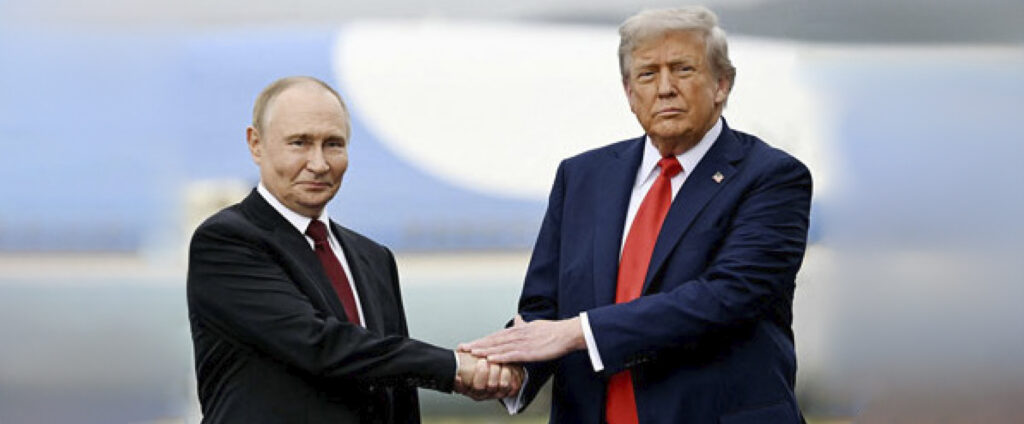
Donald Trump, never one to hide his light under a bushel, likes to claim repeatedly that he has brokered eight peace deals worldwide. There is one conflict however that he has most definitely not solved – the all-out war between Ukraine and Russia which has now lasted for four years and three months. Before being elected president for a second term, Trump claimed he would end the war in a single day. Yet US Secretary of State Marco Rubio recently admitted peace talks had stalled. However, he added an intriguing comment: “If someone else would like to handle it, they should.”
The time has come for Europe to take the lead in talks between the two sides and, equally importantly, in any security guarantees emanating from a deal. Trump’s major problem is that he has been too impressed by Russia’s military capabilities and too trusting of Vladimir Putin, the Russian President. When Putin tells Trump he will take all of Ukraine unless a peace deal – favourable to Russia – is made, Trump passes on that message in a rant at Volodymyr Zelenskyy.
The time has come for Europe to take the lead
Yet, the reality is that Russia is not winning despite believing it could conquer Ukraine within weeks, if not days, of its February 2022 all-out invasion. Today some 20% of Ukraine’s territory, including Crimea and much of the Donbas region, remains in Russian hands but the invaders have made no significant gains for some time. In fact, the minimal day-to-day territorial gains are now being made more by Ukraine than Russia.
This brutal war has resulted in up to 2.5 million casualties – dead and wounded – with only one side, Russia, being the aggressor, and one side, Ukraine, the victim. Every other nation in the world should therefore morally be backing Ukraine but, of course, international politics is never that simple.
On a personal level, the US President dislikes Zelenskyy, a hangover from the November 2024 presidential election when Trump believed Ukraine favoured a win for the Democrats rather than the Republicans.
How can any nation or any leader negotiate with someone who irrationally changes his position on a regular, sometimes daily, basis?
Over the past 16 months, Trump has tried to bully Zelenskyy into first, an unfavourable rare minerals’ deal, and later, an unfavourable peace deal, but the Ukrainian president has shown time and again that he will not have unacceptable agreements imposed on his nation.
Trump has also been far too inconsistent in his dealings with Ukraine. For example, last September he wrote on Truth Social: “I think Ukraine, with the support of the European Union, is in a position to fight and WIN all of Ukraine back in its original form.” Yet, just days later, Trump was publicly berating Zelenskyy for refusing to hand over land to Russia that had not yet even been taken.
How can any nation or any leader negotiate with someone who irrationally changes his position on a regular, sometimes daily, basis? When Trump took office for a second time, he appointed the astute retired General Keith Kellogg as US Special Envoy to Ukraine and Russia.
Yet, within weeks, after objections from Russia that Kellogg was too pro-Ukraine, the General’s role was demoted to that of Special Envoy to Ukraine only. Instead, Steve Witkoff, a businessman and Trump ally who Ukraine considered too sympathetic to Russia, was appointed to negotiate with Putin and his cronies.
Despite having helped broker the ceasefire between Israel and Hamas and the deal to bring home the hostages, Witkoff has spurned invitations to visit Ukraine and is not familiar with the country. With Trump and his senior team now pre-occupied by Iran, what is needed is a senior European diplomat who is trusted by both sides – admittedly easier said than done but not impossible.
Putin has indicated that his preferred peace negotiating partner would be Germany’s Gerhard Schröder. The former German Chancellor is a long-standing friend of the Russian leader and controversial because of his work for Russian state-owned energy firms. This makes him unlikely to be considered neutral by Ukraine or other European nations.
Europe is also capable of taking the lead on the security guarantees that Ukraine would need for a peace deal. Countries bordering or close to Russia such as Germany, Poland, Finland and the Baltic nations are now far more prepared for war than they were four years ago.
A re-invigorated Europe surely now deserves the chance to prove it can succeed where the US has failed.
However, the US would need to be involved in security guarantees too because their military might would certainly make Putin think twice before breaking any agreement.
Ukraine would certainly not want to lose the US as a military and diplomatic ally. In the near future, Ukraine cannot replace critical American capabilities, notably intelligence gathered from US satellites that has given Ukraine “eyes and ears” on the battlefield. Of course, if Europe is to take the lead in peace negotiations, it would need to step up on many fronts and get key EU and other countries, notably the UK, to be united in their aims, once again perhaps easier said than done.
For starters, Europe must not be tempted to open up a market for Russian oil and gas or lift any sanctions in return of a semi-decent ceasefire and, eventually, peace. There are no easy solutions which is why the current war in Ukraine is the longest and most deadly in Europe since the Second World War.
However, President Trump has had 16 months, rather than the single day he said he needed, to negotiate a peace deal and, with the two warring sides still far apart, his enthusiasm for finding a resolution appears to be waning. A re-invigorated Europe surely now deserves the chance to prove it can succeed where the US has failed.
Read this article on Express.co.uk
DOWNLOAD PDF