Published on ConservativeHome.com on 12 May 2026.
As the war in the Middle East draws global attention away from Ukraine, the Russia-Ukraine war is only intensifying. The spring campaign is now in full swing causing substantial casualties on the battlefield. At the same time, Ukraine has mastered its strategy of conducting deep strikes against Russian oil refineries, forcing Russia’s Vladimir Putin to state over the weekend that the war may be nearing its end and the trilateral talks between the US, Ukraine and Russia may finally be on the horizon.
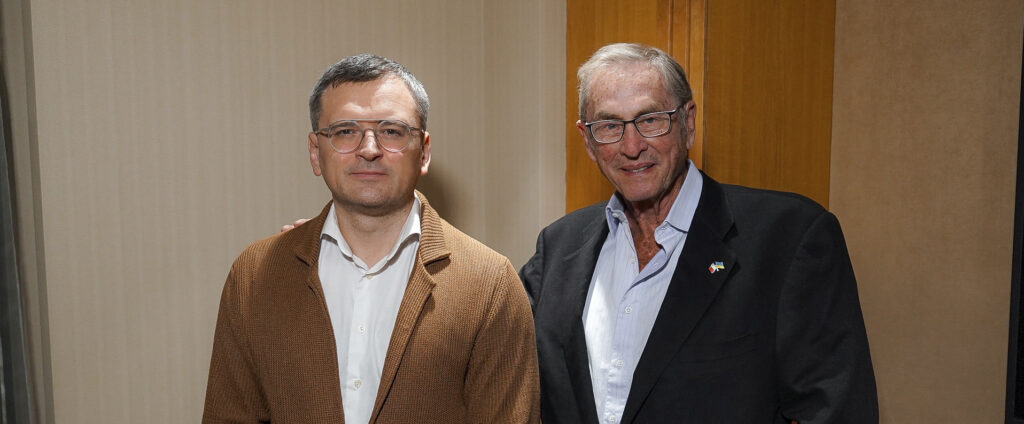
With the world’s focus increasingly fixed on Iran and the wider region, I sat down with one of Ukraine’s most prominent voices – its former foreign minister and now a non-resident Senior Fellow at the Harvard Kennedy School’s Belfer Center, Dmytro Kuleba – to discuss the trajectory of the war, the limits of diplomacy, and what lies ahead.
On the trajectory of war
Kuleba is careful to distinguish between optimism and realism. “I am not a pessimist,” he says. “I am an optimist – but a realistic one”. By his measure, Ukraine has already achieved a strategic victory. Russia’s initial objective – to destroy Ukrainian statehood – has failed. Ukraine remains a sovereign and internationally recognised state, firmly on the path towards European integration.
“Russia wanted to eliminate Ukraine as a state and reintegrate it into the ‘Russian world’. That has failed. Ukraine will be part of Europe and a member of European Union. On that account, we have already won. This war is not about whether Russia achieves its goals – it will not. It is about where the line is drawn.”
Victory, loss, and historical perspective
Kuleba offers a nuanced, almost philosophical view of victory. “History is tricky,” he reflects. “There are victories in losses, and losses in victories.” Even if Ukraine ultimately prevails strategically, it will do so at immense cost – both in human lives and territory. That reality, he acknowledges, will be difficult for many Ukrainians to accept. “Many will see the outcome as a loss. But from a historical perspective, Ukraine will have won.”
Crucially, he rejects the notion that the war will end through a comprehensive negotiated settlement. “This is not that type of war. There will not be a deal that resolves everything. There may be a ceasefire – but a ceasefire is not the end of the war.” Instead, he frames the conflict in existential terms: a struggle between Ukraine as a sovereign European state and Russia as an imperial project. “In the end, one of these will remain. Either Ukraine as an independent European nation – or Russia as an empire.”
Territory and the politics of compromise
When asked how much land Ukraine might be prepared to concede, Kuleba dismisses the premise. “It is not a question you can answer in advance. What cannot be sold to the public today may become acceptable tomorrow.” More importantly, he argues, is what Ukraine does after the war. He outlines two starkly different paths: one defined by revanchism, the other by reconstruction and acceptance. “You can raise generations on the idea of revenge. Or you can accept the reality and build something better on what remains.”
The real dilemma, however, lies in trust – or rather, the absence of it. Ukrainians fear that any concession will simply invite further Russian aggression. “If people believed that giving up territory would end the war forever, the calculation would be different. But they do not believe that.”
On Donald Trump and the limits of trust
Kuleba is blunt when discussing Donald Trump. “Who said Ukraine trusts him?” he replies when asked whether Trump is a credible mediator. For Kuleba, trust is irrelevant in international politics. What matters is balance and interest.
“No country should place full trust in another – not even its closest partners. Everyone pursues their own interests.” He interprets Trump’s worldview not as pro-Russian, but as fundamentally transactional and hierarchical. “He sees the world as a system of great powers. In that system, smaller nations must adapt.”
This, Kuleba suggests, explains why Trump appears willing to pressure Ukraine for concessions: not out of allegiance to Moscow, but because he views such pressure as natural.
The collapse of the ‘rules-based order’
Kuleba argues that the broader international system underpinning post-Cold War stability has already eroded. “The rules-based order does not exist anymore,” he says.
In his view, the system was always Western in design – and has been weakened by the rise of non-Western powers unwilling to accept its constraints. “The West became stronger under these rules – but others have now caught up. The world has changed.”
He points to a growing divergence between Western alignment and the looser, more fluid relationships among countries such as China, India, and Brazil. “The West is still coordinated. The non-West is not – but it is strong enough to shape the future.”
What would force Russia to stop?
Kuleba identifies two decisive factors that could compel Vladimir Putin to agree to a ceasefire. Firstly, a stabilised front line, and secondly, severe economic pressure.
“All wars end when resources run out, or when the cost becomes unbearable,” he says.
In his view, current Western efforts have not yet reached the level required to trigger such a shift. “Putin must feel that continuing the war is no longer sustainable – economically and militarily.”
Russia’s internal pressures
Even if a ceasefire were reached, Kuleba warns that Putin would face a domestic challenge: convincing Russians that the outcome constitutes victory. “Many Russians went to war believing they would destroy Ukraine,” he notes. “They will not easily accept anything less.” This creates a paradox. While war sustains the regime, it also raises expectations that may prove difficult to meet.
“He has built a system that depends on conflict. But that same system makes compromise harder.”
China’s role: a calculated balance
Kuleba offers a striking interpretation of Xi Jinping’s position. “China does not want Russia to win – but it does not want Russia to collapse either.” Instead, Beijing benefits from a prolonged conflict that weakens Russia while keeping it dependent.
“The more exhausted Russia becomes, the more it relies on China. That strengthens China’s position.” At the same time, Kuleba argues, China has little incentive to allow a decisive end to the war unless its own strategic interests are secured.
Europe: there is progress, but it’s not sufficient enough
Kuleba is measured in his assessment of Europe. “It would be unfair to say Europe has failed,” he says. “It has done more than anyone expected in 2022.”
Yet he is clear that the response has been insufficient.
“Has Europe done enough? No.”
He attributes this partly to structural limitations: the EU was not designed for crises of this magnitude. Only recently – prompted in part by wider geopolitical shocks has Europe begun to adapt.
The real test, he argues, lies in defence industrial capacity. “If Europe cannot build a coherent defence industrial base, then talk of a new security architecture is meaningless.” Despite the challenges, Kuleba is confident that Ukraine will join the European Union. “This is no longer just a technical process – it is a political moment.”
He draws a historical parallel with German reunification, suggesting that major geopolitical shifts often override procedural constraints.
“Europe sees Ukraine as a historic opportunity. That changes everything.”
A decade to rebuild
Looking ahead, Kuleba emphasises the need for stability above all else. “Ukraine needs ten years of internal peace,” he says. If that can be achieved, he believes the country could follow a trajectory similar to Poland’s post-Cold War transformation. If not, the risks are stark.
“Without stability, Ukraine could become something closer to Lebanon.”
A war without a simple ending
Kuleba’s message is ultimately sobering. There will be no neat resolution, no single agreement that ends the conflict.
“This war will not end with a deal,” he repeats. Instead, it will evolve – through ceasefires, shifting fronts, and long-term geopolitical change – until one underlying reality becomes unavoidable.
Dmytro Kuleba is one of the most prominent voices on Ukraine, both within the country and internationally, and he certainly played a pivotal role in building Western support in the early days and years of the full-scale war. Much of the support Ukraine has secured in 2022, compared to the initial Russian invasion of 2014, is often attributed to the oratory skills of President Volodymyr Zelenskyy. However, Kuleba’s role cannot be overstated. Through quiet diplomacy and persuasive argumentation, he has helped build alliances in support of Ukraine grounded in friendship, trust and a clear sense of respect for Ukraine that his communication consistently conveys.
It is therefore no surprise that Biteback Publishing has recently released a book centred on Dmytro Kuleba called “Words of Defiance”. The book draws on Kuleba’s wartime speeches and focuses on Ukraine’s global diplomatic campaign to secure international military, humanitarian and political support during the country’s fight for survival.
“Ukraine has already survived. That is the foundation of victory. The rest will take time”, he said, as he concluded our interview in Kyiv.
The book “Words of Defiance. Wartime Speeches by Ukraine’s Foreign Minister Dmytro Kuleba” by Bjorn Berge can be ordered here https://www.bitebackpublishing.com/books/words-of-defiance.
Read this article on:
ConservativeHome.com