Published in the Daily Express on Tuesday 27 October 2026.
In his latest Kyiv dispatch, Lord Ashcroft meets a Ukrainian drone operator who hopes to return to the frontline after being wounded twice in action.
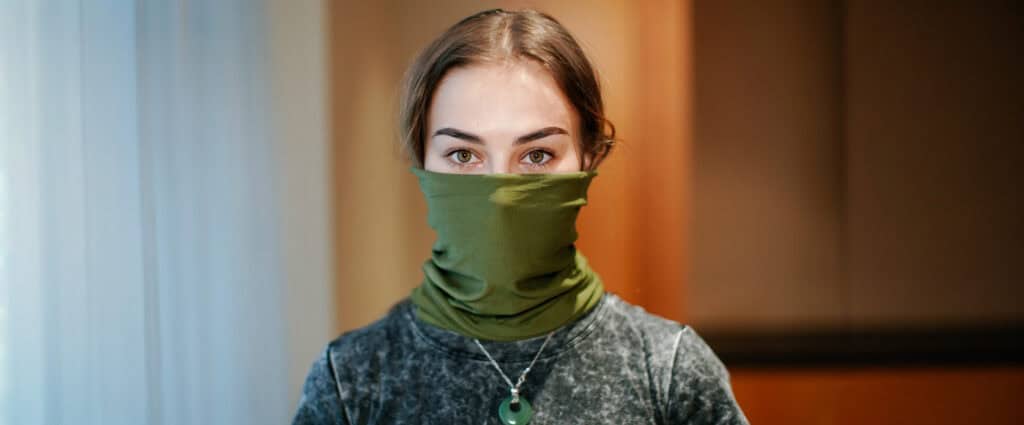
First impressions can be deceptive. Iryna is 22 years old, 5ft 3in tall, weighs under seven stone and walks with a limp. With her petite features and long, light brown hair, she looks anything but a killing machine. Yet this remarkable young woman has served with courage and distinction in the Armed Forces of Ukraine for three years, often commanding men twice her age on the frontline. She is technically skilled at building FPV (First Person View) attack drones and even more talented at piloting them.
Now discharged from the Army – she hopes only temporarily – after being badly wounded twice in two years, Iryna exemplifies the courage of Ukrainian women during her nation’s four-and-a-half-year all-out war with Russia. During her service, she says she has killed more than 50 Russian soldiers using FPV drones and it is for this reason that she asks me not to use her surname and that she is photographed wearing a green scarf over her face so she cannot be identified.
On the day of Russia’s all-out invasion, Iryna was a 17-year-old student studying at a university in Kharkiv and living in a dormitory in Ukraine’s second largest city which lies close to the frontline. At around 5am on February 24, 2022, she was woken by loud explosions and realised the war had started.
“I couldn’t believe what was happening,” she said. Iryna remained in Kharkiv for a month, sheltering for much of the time from missiles and shells in the city’s overcrowded underground stations. During this time, several people she had studied with were killed or injured in Russian attacks.
I decided I wanted to join the infantry so that I could be on the battlefield and physically fight against the enemy
With the situation getting increasingly dangerous and with food and fresh water in short supply, she eventually boarded an evacuation train and returned to her family home in the Poltava region, further from the frontline. After another month and as the war escalated, her mother sent Iryna, an only child who did not know her father, to neighbouring Poland for safety.
During her two months in Poland, she found it hard to adjust to normal life. “I felt traumatised. I was a 17-year-old kid who had been through a lot,” she said. So she returned to Ukraine to be with her mother. It was then that I first had the idea of joining the Armed Forces of Ukraine,” she told me. However, Iryna’s mother was against the idea and for the next year Iryna worked as the director of a theatre troop.
However, in September 2023 and by then 19 years old, Iryna went to a recruitment centre where she was accepted for a military role. “My original intention was just to make myself useful in some way,” she said. Iryna was initially given a clerical job but, after some basic military training, she set her heart on a combat role. “I decided I wanted to join the infantry so that I could be on the battlefield and physically fight against the enemy who were killing thousands of people on our land,” she said.
Her early experiences, with a small unit in the Kyiv region tasked with shooting down enemy drones, were uninspiring because she worked with men much older than her who were not fully committed to their role. However, by using a semi-automatic assault rifle to shoot down drones, she proved to be a good shot. In early 2024, Iryna was transferred to the Donetsk oblast/region where she served in the infantry. The loss of comrades, one of whom died in her arms, spurred her on to make a difference on the battlefield.
To start with I thought: ‘am I really killing a human being?’ But after I had killed 50 enemies, I stopped counting
Next, after training with drones, she was transferred to another frontline unit. At just 20 years old, she was eventually put in charge of her own five-strong drone team, working with four men much older than her. In this role, she was also the first woman strike drone operator in her battalion. “I became a sapper and a technician, I could programme the drone, I could assemble the explosives and I could pilot it as an operator,” she said.
“I got on well with all the men in my team – three pilots and a technician. We had a warm relationship towards each other. Of course, they knew I was young and they had more combat experience than me. But they also knew I was smart in the sense of my knowledge of FPV drones. So they respected my skills and I respected theirs. We were like a family and we discussed things together.”
I asked Iryna how she felt when she killed Russian soldiers using FPV goggles and a screen with a map and the live images from the attacking drone. “To start with I thought: ‘am I really killing a human being?’ But after I had killed 50 enemies, I stopped counting numerically and psychologically.
“When I am piloting a drone, I have a strong feeling that I am defending my home and that I am defending those who are sitting quietly at home drinking coffee or those mothers who are bringing their children to the kindergarten. It helps me to have the feeling that I am doing the right thing, standing up for my loved ones and stopping the evil things they have done to us. It’s harsh but this is my response to their actions. It is what it is.”
Iryna then showed me a 24-second film – taken from an FPV drone that she was piloting – of one of her “kills”, stopping the images short of the moment the Russian soldier was eliminated. The enemy soldier, having spotted the drone above him, can be seen running away and at the same time looking up, praying for the drone pilot not to kill him. The soldier was in the so-called Occupied Territories – land Russia has seized from Ukraine – and Iryna was flying the drone from a position two miles from the frontline.
It may sound cruel but for me it was an honour to eliminate one of their soldiers – a man who was on our land attacking our positions.
Iryna did not spare his life, telling me: “He was very close to our position and he made the wrong decision. We had seen videos that the Russian assault brigade had posted showing how they were killing our men. “It may sound cruel but for me it was an honour to eliminate one of their soldiers – a man who was on our land attacking our positions. The reality I have come to know is that he deserved to be killed.”
However, in November 2024, Iryna was badly wounded in the Donetsk region by enemy artillery fire, leaving her with 23 fragments of shrapnel in her body, including one close to her heart. Yet she defied doctors’ orders to leave hospital and returned to duty just a week later because she knew her comrades needed relieving on the frontline.
In August 2025, Iryna was wounded even more seriously, this time by a glide bomb while operating in the Zaporizhzhia region. On this occasion, she broke her left knee, an injury which more than a year on still causes her immense pain. This resulted in her being demobbed from the Army in April of this year because of her disability, yet since then she had still acted as a drone instructor to service personnel.
If I could turn back the clock three years, I would still join the Army … I have no regrets
Today Iryna, who retired as a company sergeant major, is both physically and mentally traumatised by what she has seen and done in war: the wound on her leg is festering and she takes both strong painkillers and anti-depressants. I asked Iryna if she had any regrets about her decision taken when she was just 19 to fight for her country’s freedom.
“If I could turn back the clock three years, I would still join the Army. It has shaped me into who I am today. I have the experience of many men aged more than 40. I have no regrets.” Unsurprisingly, Iryna’s mother is immensely proud of her, especially as Iryna has twice been decorated for her courage.
Iryna, who is single after a brief marriage to a non-military man that failed because she was away from home for so long, added: “Today I am happy if I have a bed, food and a shower – simple things. But I hope to rejoin the Army if my leg can be fixed by surgery.”
In the long term, like most people living in the war-torn nation, she yearns for peace. “First, I want the war to end on Ukraine’s terms. Then I want to have a happy, fulfilled family with a good husband and loving father who sets a fine example to our children. This is my dream.”
Read this article on Express.co.uk
DOWNLOAD PDF