Published on ConservativeHome.com on 02 July 2026.
I met President Abdirahman Mohamed Abdillahi known as “Irro” in Jerusalem in a historic hotel where many great leaders of the past have stayed.
That setting felt entirely appropriate for what was, by any measure, a moment of diplomatic significance – the opening of Somaliland’s first official embassy in Israel and what its leadership regards as the beginning of a new chapter in its long quest for international recognition.
I had previously travelled to Somaliland last spring to explore the breakaway territory of Somalia for myself, to assess whether the arguments for its independence were legitimate. They were. What I found was a country significantly more secure than Somalia in the south, functioning democratically, and determined to position itself as a reliable partner and ally to Western countries. The question I was left with then still stands – if a territory has built stability, held democratic elections and demonstrated consistent self-governance over decades, why should we deny it the right to be recognised?
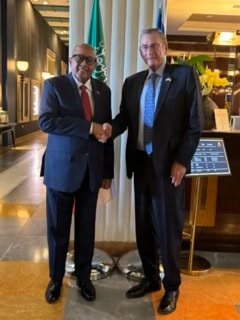 This time, I came to Jerusalem to meet the President directly and to speak with him about Somaliland’s independence and its future place in the world.
It was clear this was no routine visit. The entire Somaliland delegation was present – ministers, advisers, security officials and diplomats – giving the impression of a government determined to project itself on the world stage. After all, for Somaliland, this was its first official state visit of this kind.
The President himself was composed and steady. He has the calm assurance of a man who knows his country intimately, and the weight of what is at stake. When he speaks about Somaliland, it is not in abstraction. It is with the precision of someone who has lived every chapter of its modern history – from conflict and fragmentation to the fragile stability it now enjoys. He answered even the most difficult questions directly, without evasion. There is little room for performance in his answers; instead, there is urgency. For him, this is not an academic debate about recognition. It is about existence.
And so we began.
“Britain said it would be second to recognise us”
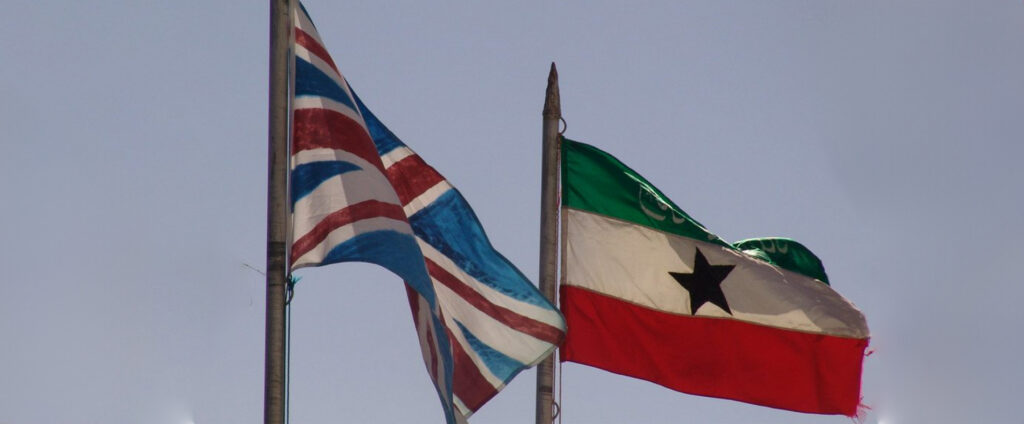
The most politically significant moment of our discussion came early, when President Irro returned repeatedly to Somaliland’s relationship with Britain. “For 35 years we were looking for the first country to recognise Somaliland,” he told me. “We found it.”
The UK always told us it would not be the first country, but it would be the second one
That reference, of course, was to Israel’s decision to open formal diplomatic relations with Somaliland and establish its embassy in Jerusalem. But it was what followed that will be noted in Westminster and beyond.
“The UK always told us it would not be the first country, but it would be the second one. Now we have found the first. The time has come.”
It is a striking assertion – not only because it places Britain not as a distant observer of Somaliland’s claims as part of its past, but as a country already embedded in its diplomatic expectations for the future. Somaliland, he argues, is not asking Britain to take a leap into the unknown, but to complete a historical step it already began.
The President was clear that recognition is not simply symbolic but essential. “Recognition is not something we can manufacture ourselves,” he said. “It is the greatest achievement when another country recognises you.” For Somaliland, Israel’s move is not merely diplomatic validation. It is a signal that long-standing political assumptions about its status may finally be shifting.
They tell us to be democratic. We are democratic. They tell us to be peaceful. We are peaceful. They tell us to hold elections. We hold elections.
A state built in isolation
If there is a central argument underpinning Somaliland’s case, it is that it has already done the work of a state without the benefits of being one. President Irro was insistent on this point. “They tell us to be democratic. We are democratic. They tell us to be peaceful. We are peaceful. They tell us to hold elections. We hold elections.”
He pointed to Somaliland’s electoral history, peaceful transfers of power and internal security as evidence of a functioning state operating without international sponsorship or formal recognition. “We have administered our country for 35 years without assistance from anyone,” he said. “We finance our security forces, our education, our health system. Everything is homemade.”
It is a phrase he returns to repeatedly: “homemade governance”. By this he means institutions built internally, without international templates provided from the outside.
The President also highlighted security reforms as one of his government’s most significant achievements, particularly the disarmament and reintegration of armed groups following internal unrest. “We demobilised 6,000 armed men and reintegrated them into society, into our most effective in the region security forces,” he said. “We did it without the United Nations, without Britain, without America.”
The implication is clear – Somaliland sees itself as a proof of concept for state-building in one of the world’s most unstable regions.
We do not need symbolism only
Israel: from symbolism to substance
Somaliland’s recognition by Israel is being presented in Hargeisa not as a diplomatic trophy, but as a gateway to practical cooperation. “We do not need symbolism only,” the President said firmly. “We need something tangible on the table for the ordinary citizens.”
He outlined several priority areas for cooperation like water management, agriculture, healthcare and technology.
Strategic geography and ambition
Beyond recognition, Somaliland is positioning itself as a strategic actor in a rapidly changing regional environment. Sitting along the Gulf of Aden and near one of the world’s most important maritime corridors, Somaliland is keen to emphasise its relevance to global trade and security. President Irro described his country as a potential “corridor for peace, security and trade”.
We can be richer than Qatar
He also spoke of interest from American companies in sectors ranging from energy and minerals to aviation and even space infrastructure.
“We can be richer than Qatar,” he said. “We have oil, gas, lithium, agriculture and a young population.”
It is a bold claim, but one rooted in a clear political objective – to shift Somaliland from the margins of diplomacy into the centre of strategic calculation.
“We were a sovereign state”
At the heart of Somaliland’s argument lies its interpretation of history.
“We were a sovereign country before we joined Somalia,” the President said. “We were recognised in 1960.”
He argues that the union with Somalia was voluntary, brief and ultimately reversed following the collapse of the Somali state in 1991. Whether this interpretation will ever be accepted internationally remains uncertain. But it is central to Somaliland’s diplomatic strategy – to present recognition not as secession, but as restoration.
We are a recipe for peace and security in the region
Britain’s unfinished role
For President Irro, Britain remains the pivotal external actor.
The historical relationship is frequently invoked: colonial administration, independence in 1960, and longstanding political and cultural ties.
“There is a very strong historical relationship with the United Kingdom,” he said. “The British gave us independence.” He also suggested that British political circles are increasingly sympathetic to Somaliland’s case, even if formal policy has yet to change. “The willingness is there,” he said.
Looking ahead
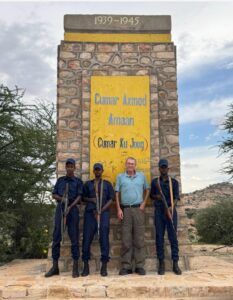 As our conversation drew to a close, I asked the President what success would look like in the coming decade. His answer was immediate. “To be seen. To be recognised. To exist fully in the international system.”
Beyond recognition, however, he also spoke of a broader ambition – to transform Somaliland into a regional contributor to peace, trade and stability.
“We are a recipe for peace and security in the region,” he said. “We want friendly relations with all our neighbours.”
And in Jerusalem, as its first embassy opened its doors, President Irro made one thing clear – Somaliland is no longer waiting quietly on the margins of history, it is moving ahead with its pursuit of independence.
Read this article on:
ConservativeHome.com