Published in the Sunday Express on 04 October 2026.
WITH their long history of war and conflict, the Kurdish people have often sought sanctuary from their enemies in the spectacular Zagros range in northern Iraq.
Indeed, “No friends but the mountains” is a well-worn proverb.
The Zagros is where a huge number of Iraqi Kurds fled in the late 1980s when President Saddam Hussein’s brutal regime not only torched thousands of villages but also launched a chemical attack on a local population, killing up to 5,000 people.
Similarly, the mountains provided a safe haven for Kurds in 2014 when ISIS (the Islamic State of Iraq and Syria) seized swathes of Kurdistan, only for the Peshmerga, the Iraqi Kurds’ own military force, to defeat the militant group in 2017 with the support of the West.
Yet today – even as war rages between the US/Israel alliance and Iran – Kurdistan seeks to provide an unlikely rock on which stability in the Middle East can eventually be built.
However, those ambitions suffered a setback last week when the US pulled out the last of its forces from Erbil, the regional capital, as part of President Donald Trump’s pledge to stop socalled “forever wars”.
The move ends a 23-year military presence in Iraq by the US after it and its allies invaded Iraq to topple Saddam Hussein back in 2003.
Such a development is worrying because, despite trying to keep out of the war with Iran, since February this year Kurdistan has endured more than 1,000 drone and missile attacks, mainly from Iranian-linked militia groups.
More than 30 people have been killed and more than 150 injured.
Last week I travelled to Erbil at the invitation of the ruling Kurdistan Democratic Party (KDP) to learn more about the semi-autonomous region.
Before I arrived, I knew the Kurds to be an ethnic group of up to 45 million people, spread mainly across Iraq, Turkey, Iran and Syria. They are one of the largest stateless groups in the world, but with a long-term desire for their own, independent nation. As I told everyone I met, the purpose of my visit was to listen and learn.
Within minutes of arriving, my perception of the region was transformed: I saw a mass of luxury residential and commercial buildings, most of them less than 20 years old, and indications of wealth and economic prosperity at every turn. I soon discovered, too, that Kurdistan is rightly known for its tolerance of a wide range of political, ethnic, religious and cultural groups, which happily co-exist throughout the region.
At his palatial home on the outskirts of Erbil, I was warmly welcomed by the legendary figure of Masoud Barzani, aged 80, who, in his long and eventful life, has seen suffering and chaos on an unimaginable scale.
If we have to defend ourselves, we will fight to the very end
Sporting his trademark red and white headscarf and choosing his softly-spoken words carefully, the President of the KDP thanked the US and the West, including Britain, for their past support.
HOWEVER, he also voiced fears that Islamic militants could once again try to seize power in Kurdistan following the US troop withdrawal. “I fear the scenario of 2014 [the ISIS arrival] may return,” he told me.
Like all the political leaders that I met over four days, His Excellency prefers peace to war. But nobody should under-estimate the bravery and resilience of the Kurds and their formidable Peshmerga forces.
“If we have to defend ourselves, we will fight to the very end,” he said.
I also met Masrour Barzani, the Prime Minister of the Kurdistan Regional Government, and he too expressed concerns that the region will be vulnerable to drones and other missile attacks. Indeed, in August his own residence was targeted by drones.
The Iraqi Government does not provide Kurdistan with substantial air defences or allow them to buy their own.
“We are not after hand-outs or boots on the ground [support from Iraqi or Western military forces] but we are powerless and defenceless against air attacks. We are on our own in a hostile environment,” the Prime Minister told me.
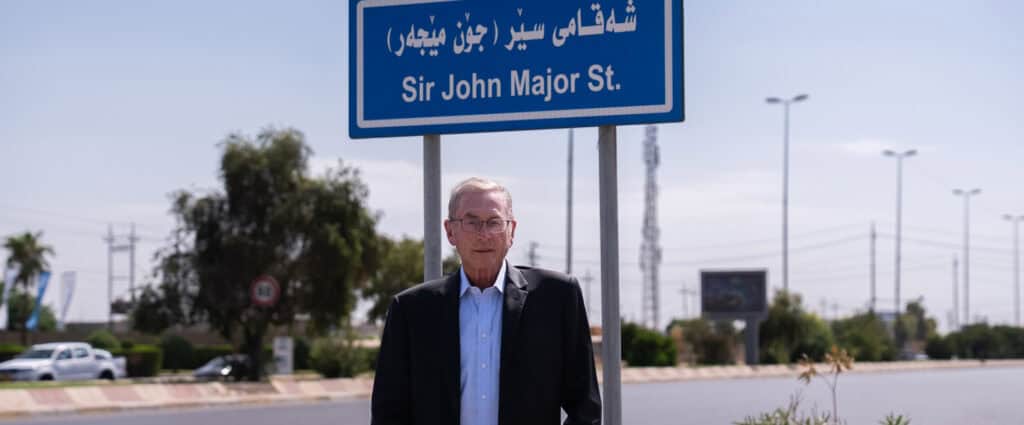
For the past four decades, the Kurds in northern Iraq have built strong ties with the West, including Britain. In 1991, during the First Gulf War, John Major, then Prime Minister, was credited with the introduction of the “no fly zone” which created a safe haven for Kurds facing the prospect of new atrocities from Saddam Hussein’s forces. Indeed “Sir John Major Street” is named in his honour in Erbil.
Although Kurds are proudly nationalist and most would ultimately like their own nation, their political leadership in northern Iraq talks with great caution about independence.
To set a deadline on such a move would antagonise many “players” in the Middle East.
The Sunnis have a fear of the past, the Shias have a fear of the future and the Kurds have a fear of the past, the present and the future!
In 2017, a referendum saw 92% vote in favour of independence for the Kurdistan region, only to see the result met with a show of military power from Baghdad, the Iraqi capital.
Furthermore, the West, Turkey and Iran all fear legthat imminent sovereignty would destabilise the Middle East further.
The Iraqi Government is mistrusted and resented in Erbil, partly for seizing control from Kurdistan of its lucrative oil pipeline, along with its revenues, and holding back a large part of the region’s budget in an alleged breach of the 2005 constitution.
There are no easy solutions to such problems. Nechirvan Barzani, the President of the Kurdistan region in northern Iraq, told me with a smile: “The Sunnis [Muslims] have a fear of the past, the Shias [Muslims] have a fear of the future and the Kurds have a fear of the past, the present and the future!” Bayan Sami Abdul Rahman, who has lived much of her life in Britain and the US in her roles as a journalist and diplomat, knows only too well the price of war and turmoil.
Her father, then Deputy Prime Minister of the region, and her brother, were killed along with more than 100 others in a terrorist attack in 2004 in Erbil, conducted by an al-Qaeda affiliated group.
BAYAN, who now lives in Erbil and acts as a senior advisor to the Prime Minister, told me: “Our neighbours cause us problems sometimes. Like other nations, we can’t choose who our neighbours are so we strive to have good relations with them.”
The Foreign Office in Britain, along with other countries, recommends only “essential” travel to Iraqi Kurdistan. Such advice inevitably puts off wealthy potential investors. Yet the conditions for investment in Kurdistan could hardly be more welcoming – foreigners are permitted to own 100% of their businesses and they are given big tax breaks too.
Safety fears put off tourists too, yet the sight-seeing and hiking opportunities in Kurdistan are endless.
I visited the magnificent Citadel, the old section of Erbil, which claims to be the oldest continually inhabited city in the world, dating back more than 6,000 years.
“I love the Iraqi Kurds …an oasis in the turmoil.
I also paid my respects at the Martyrs’ Memorial, which represents the collective suffering and sacrifices of the Kurds.
Knowing I was visiting Kurdistan, my friend Stephen Harper, the former Prime Minister of Canada who visited the region in 2015, messaged me: “I love the Iraqi Kurds …an oasis in the turmoil.”
I would echo those warm sentiments and I hope that Kurdistan and its people, if and when the time is right, achieve the sovereign homeland that their courage, resilience and patience deserve.
With their ultimate dream of independence in mind, I will end as I began with a Kurdish proverb: “Little by little, the thread becomes a carpet.”
DOWNLOAD PDF